China has become the answer both sides reach for in the argument over whether advanced artificial intelligence should move faster or slow down. In Washington, national advantage is used to justify speed. In Beijing, calls for limits are treated with suspicion. That framing misses the decisive competitive fact. China is building its AI position through a connected system of schools, universities, engineers, open models, industrial demand, computing infrastructure, and state strategy.
The argument about speed has become an argument about China
Le Monde reported that United States President Donald Trump rejected calls to pause or pace frontier development because of competition from China. The Guardian reported that Beijing rejected what it described as threat narratives even as a senior Chinese security official called AI a central arena of technological and strategic competition. El País described the same dispute as a fight over who gets to set the pace and rules of development.
The positions conflict, but they share a premise: AI capacity now matters at national scale. Washington treats continued speed as protection against losing advantage. Beijing treats exclusionary controls and threat language as attempts to constrain its development. A model leaderboard or dramatic product launch captures only one layer of that competition.
The harder question is whether strategic rivals can create rules that both can verify. Safety coordination would require comparable evidence about capabilities, incidents, and safeguards across systems that do not share governance standards. Competition makes that access more important and less likely at the same time.
The history of China's AI industry extends through several policy cycles, but the current system is best understood through its active institutions: education, talent, research, infrastructure, and industrial deployment.
Schools are part of the industrial pipeline
China's competitive system begins well before a researcher joins a frontier lab. The national AI Plus Education action plan calls for an AI education system covering every stage of schooling by 2030. The plan links classroom use, teacher capacity, research, infrastructure, and talent development rather than treating AI literacy as a standalone computing lesson.
That direction is already visible in local policy. China's State Council news service reported that Beijing requires at least eight hours of AI classes each year for primary and secondary students, with experts from universities, research institutes, and technology companies brought into schools. Eight hours cannot create an engineer. It can make AI a standard part of the education system and give more students an entrance to later study, competitions, research, and employment.
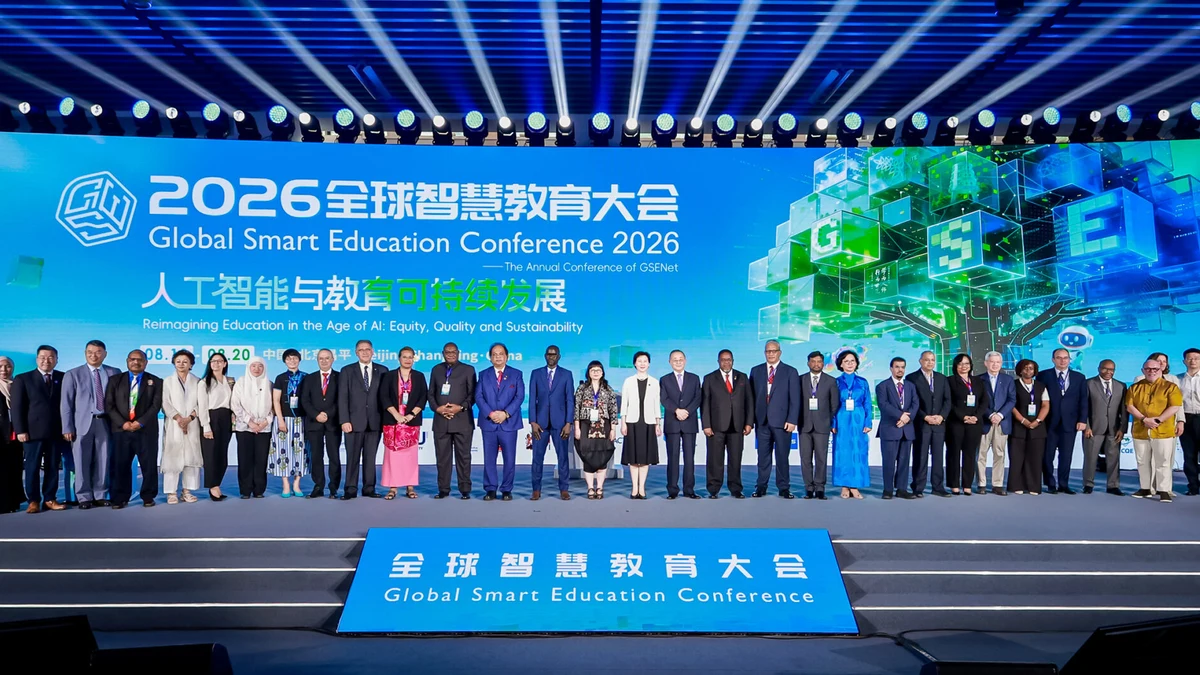
The featured photograph comes from the 2026 Global Smart Education Conference in Beijing , co-organized by UNESCO's Institute for Information Technologies in Education and Beijing Normal University. The conference shows how China also presents AI education as an international policy project, not only a domestic workforce program.
Talent is increasingly produced and retained at home
Talent data supplies the next link. MacroPolo's Global AI Talent Tracker found that researchers of Chinese origin represented 47 percent of the world's top AI researchers in its 2022 sample, up from 29 percent in 2019. The United States remained the leading destination and housed 60 percent of top AI institutions in the tracker, while a larger share of Chinese researchers was working in China.
DeepSeek made that shift easier to see. A Stanford HAI analysis of 223 authors across five DeepSeek papers found that nearly all were educated or trained in China. About a quarter had some United States experience, and most of that group returned to China.
The data does not rank one education system above another. It reveals a circulation system that the familiar brain-drain narrative no longer explains. Domestic universities produce researchers, overseas experience can return, and visible local model teams give graduates reasons to stay. Schools widen the entry point while laboratories and companies create destinations.
Resource constraints change the engineering strategy
China still faces a major constraint in advanced computing. The 2026 Stanford AI Index records a substantial United States lead in top-tier models, private investment, and data-center count. It estimates 2025 private AI investment at $285.9 billion in the United States and $12.4 billion in China, while noting that private investment figures understate Chinese state-guided capital.
The same Index says the performance gap between leading United States and Chinese models has effectively closed, with the top models separated by a single-digit percentage gap in March 2026. China also leads in AI publication volume, citations, patent output, and industrial robot installations. No one measure settles the comparison. Together, they describe a system with less frontier compute and private capital, but substantial research output and industrial reach.
Reporting from the World Artificial Intelligence Conference shows how the ecosystem is responding. The Asia Society's Center for China Analysis found that China is adapting to compute scarcity through hardware clustering, software optimization, municipal support, and open model distribution. Huawei's Atlas 950 SuperPoD is designed to link thousands of domestic accelerators into one logical system. Its announced scale still needs independent performance measurement, but the engineering strategy is clear: compensate for weaker individual chips through interconnects, cluster design, and software work across the stack.
That is why Newsroom's analysis of Nvidia's empire beyond AI chips matters here. Competitive advantage can sit in networking, software, developer adoption, and system integration as much as in a processor. China is pursuing its own stack strategy under different commercial and political constraints.
Open models turn scarcity into distribution
Open-weight releases give Chinese developers another route to global reach. A model whose trained parameters can be downloaded, adapted, and deployed outside its maker's hosted service can gain users even when its developer has less capital or less access to advanced chips. Open weights do not automatically provide the training data, development process, or unrestricted license associated with fully open-source software. They still make distribution a strategic resource.
That strategy joins model availability to a large domestic industrial base. Manufacturers, robotics companies, device makers, local governments, and service firms can become deployment partners and test environments. The AI Index's industrial robot figures matter because they identify a place where software capability can meet physical production at scale.
Newsroom's report on AI for circuit design and simulation defines the evidence boundary. A benchmark can demonstrate progress on a technical task without proving industrial adoption. China's competitive position depends on both layers: research performance and the institutional capacity to move useful systems into production.
Strategy can coordinate, but it can also distort
National plans can connect education, funding, infrastructure, procurement, and standards. They can also reward compliance, duplicate investment, and keep weak projects alive. Local incubators do not guarantee durable companies. Patent volume does not guarantee commercial value. Publication volume does not guarantee a frontier breakthrough.
Political control creates another tension. Beijing promotes international cooperation while treating information and model behavior as matters of national security. The same institutions that accelerate adoption can narrow research freedom or shape which risks are discussed publicly. American export controls add pressure from outside, increasing both the cost of frontier work and the incentive to build alternatives. Neither system is a neutral market test.
The slowdown debate makes the governance gap unavoidable. Newsroom's related analysis, AI Leaders Agree on Evaluators, Not Yet on a Slowdown, asks whether monitoring has authority behind it. A credible international arrangement would need access beyond a handful of American laboratories, plus methods for comparing capabilities and incidents across different legal and political systems.
The competition is between pipelines
The United States retains major advantages in capital, computing infrastructure, top institutions, and frontier model production. China has built depth in research output, engineering talent, open-model distribution, industrial deployment, and coordinated demand. Neither profile amounts to an overall victory.
The competition is between pipelines. One converts capital, chips, elite institutions, and platform companies into frontier systems. The other links a broad education base, returning talent, constrained-resource engineering, open distribution, manufacturing, and government coordination. Each has weaknesses, and each is becoming harder to judge through a single release.
When political leaders invoke China to argue for speed or restraint, the useful question is not who is ahead on a given day. It is which ecosystem can keep turning education into talent, talent into research, research into deployed systems, and deployments into another generation of capability. That cycle, rather than a snapshot leaderboard, is where global AI competition is being decided.