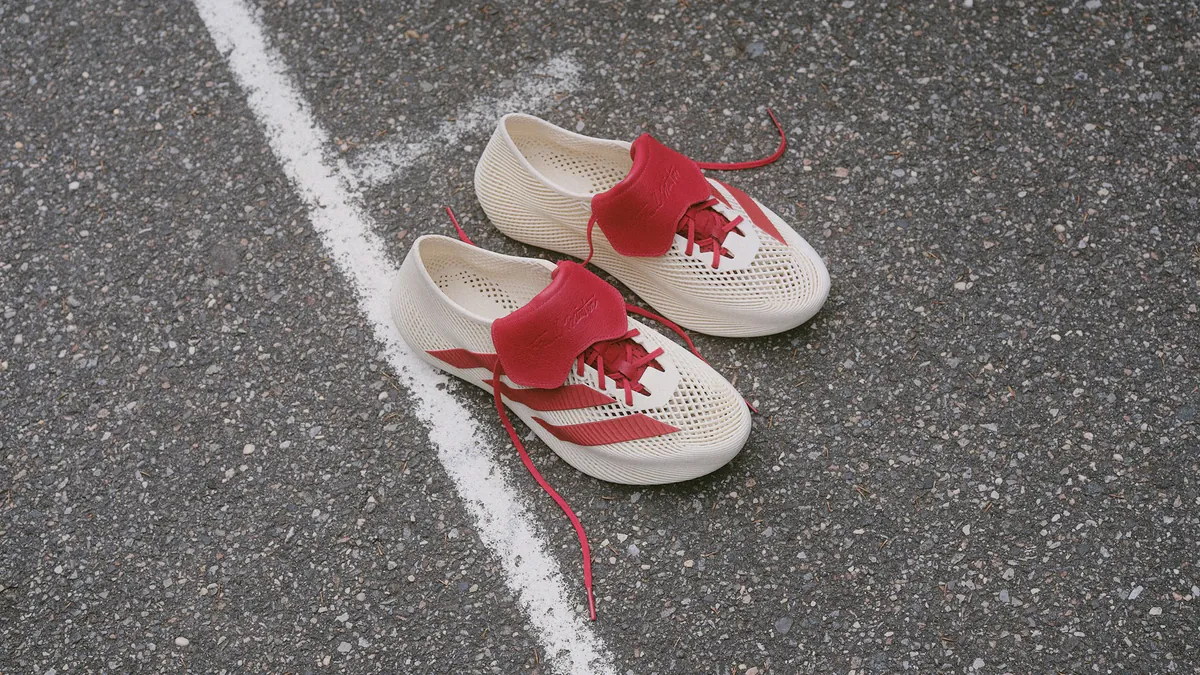
adidas and Tyrrell Winston have built The Athlete around a compelling fashion tension: precision engineered to look alive. The Fall/Winter 2026 capsule sets the intricate lattice of a fully 3D-printed CLIMACOOL shoe against relaxed clothing cut with inverted panels, raw hems, and generous volume. Launched on September 8, the collection makes technical sportswear feel less pristine and more personal.
The contrast is strongest when the pieces are read as one wardrobe. Repeated shoe geometry brings rhythm and control. Exposed seams and unfinished edges loosen that order, drawing the eye back to how a garment is assembled. The result is an off-duty uniform with enough friction to keep pale tonal dressing from becoming anonymous.
A sculptural shoe grounded by familiar codes
The official adidas announcement describes the TW CLIMACOOL as a fully 3D-printed shoe built around a multidimensional lattice. Its folded tongue introduces technical mesh and leather, while red stripes repeat the tongue's color across the open cream structure.
That flash of red does more than sign the shoe. It gives the eye a clean line through a surface dense with apertures, ribs, and changing depth. The lattice turns the entire silhouette into one continuous sculptural object, but the folded tongue pulls it back toward a recognizable sneaker vocabulary. This is where the design finds its balance: futuristic fabrication held in place by familiar sportswear codes.
3D printing builds physical objects from digital models, layer by layer. Here, its visual contribution is unmistakable. The technology allows structure and surface to become the same thing, giving the shoe an airy, architectural presence. adidas also presents the construction in terms of airflow, lightness, and a fit between a slide and a sneaker. Those performance qualities remain the brand's proposition until they are tested in wear.
Raw hems give the clothes their character
The capsule extends the same push and pull through the TW Stadium Top and Pant, varsity-inspired pieces, and a multipurpose tote. Reversed panels and exposed finishing move construction from the inside of a garment to its visible surface. Small gold accents sharpen the otherwise restrained palette.
Raw edges can easily become a decorative shorthand for rebellion. Here they work more subtly, giving soft, roomy separates a sense of handling and process. The finish is deliberate rather than distressed through use, and the collection makes no broader material or circularity claim. Its interest lies in appearance and construction: clothes that reveal enough of their making to avoid looking over-resolved.
The campaign's seated tonal look makes that argument particularly well. Wide trousers create the dominant line, pooling lightly above the shoes, while the pale top and bottoms form a continuous field around the body. The CLIMACOOL then punctuates the silhouette with texture and red. Although the shoe is the technical centerpiece, the trousers establish the attitude. Their volume turns an experimental object into part of an easy, complete look.
This is confident styling because it resists the urge to make every element compete. The clothes carry the silhouette, the shoe supplies the engineered detail, and the tote and basketball extend Winston's sporting language without overwhelming the ensemble.
Winston brings the poetry of used objects
Tyrrell Winston has long worked with found objects and the histories they gather. His gallery, Library Street Collective , places basketballs and other recovered materials at the center of that practice. Sport, repetition, wear, and time are therefore more than campaign decoration in this collaboration.
The translation into new clothing is necessarily indirect. A factory-finished raw hem does not possess the history of a found basketball. What carries across is Winston's sensitivity to surfaces that suggest touch and duration. In The Athlete, signs of process become design choices: exposed construction, relaxed proportions, and a shoe whose repeated lattice seems to record movement before it is worn.
adidas identifies the capsule as the partnership's second chapter after The Artist. Winston frames the new collection around the daily effort shared by creative and athletic practice. The wardrobe gives that idea a persuasive form. Rather than literal performance kit, it offers a uniform for the intervals around work: roomy, tactile, and composed enough to move between settings.
The collection succeeds through contrast
The Athlete is most convincing when its pieces remain in dialogue. The shoe's geometry needs the softness of the trousers. The raw hems need the clarity of the tonal palette. The red accents need the cream field around them. Remove that contrast and the individual gestures risk becoming familiar streetwear devices. Together, they produce a collection with a distinct visual cadence.
For readers considering a piece, the local product listing remains the source for current sizes, garment measurements, materials, and returns. The adidas Store on Amazon I may earn a commission offers broader brand context, though this edition was not verified there.
What can already be judged is the fashion proposition. The Athlete brings digitally precise footwear into contact with clothing that celebrates seams, edges, and volume. It is a thoughtful meeting of engineered repetition and human irregularity, expressed with enough restraint to let both sides register.