The practical answer
Fashion from Below explains garment production through workers, workshops, households, and cooperative organization in Buenos Aires. Its practical value is a more precise account of who makes clothing and who controls production decisions. The publisher provides the complete open-access book alongside the print edition.
Fashion Starts at the Worktable
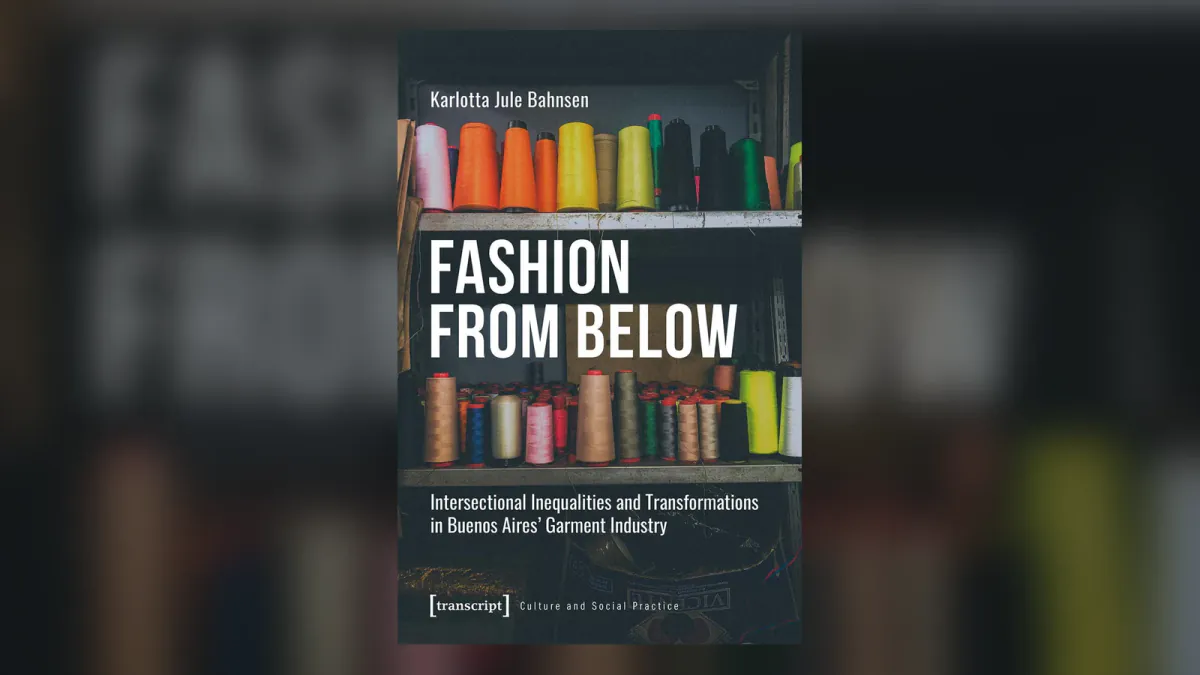
Karlotta Jule Bahnsen's Fashion from Below I may earn a commission places the people who assemble clothes at the center of fashion's story. Published open access by transcript Verlag , the study follows Bolivian migrant workers and collective organization in the garment industry of Buenos Aires. Its subject is not the finished look alone, but the workshops, wages, neighborhoods, migration routes, household arrangements, and ambitions from which that look emerges.
This is a compelling change of altitude. Fashion is often narrated from the runway, campaign, boutique, or designer's studio. Bahnsen begins at the worktable. Her ethnography traces how workers move through migration and garment production, then examines the cooperative structures through which they negotiate precarious conditions and imagine greater control over their labor.
The book appeared in Germany on June 6, 2026. Columbia University Press , its United States distributor, lists the English paperback for August 2026 and confirms its 318 pages and ISBN 9783837680669. Those territorial dates belong to the same edition, a book whose open format makes its argument unusually accessible.
Buenos Aires Is Cut Into Every Garment
In Bahnsen's account, Buenos Aires is an active part of the production system. Home workshops, industrial spaces, wholesale markets, commercial streets, transport routes, migration networks, and administrative offices form a dense urban pattern around garment work. The city shapes where production happens, how it moves, and whose labor becomes visible.
That geography gives the familiar supply-chain diagram a more human scale. Clothing does not pass cleanly from factory to store. Work circulates among homes, workshops, cooperatives, labels, and markets. Access to machinery and capital matters. So do family ties, immigration status, policing, the distance between assembly and sale, and the time required to move between paid labor and domestic responsibility.
The book's introduction locates its ethnography in a textile cooperative and among workers who welcomed Bahnsen into their workplaces and homes. That specificity is one of its strengths. Rather than flattening an industry into a single account, the research follows particular relationships across labor, migration, gender, and collective organization. The result is a richly situated portrait of how fashion is made and how the people making it negotiate their place within the system.
The Cooperative Becomes a Design Space
The cooperative is where the book's analysis becomes especially vivid. Bahnsen reports that collective organization helped create a more suitable production space, reduced fear around inspections, strengthened price negotiations, and made it easier to separate paid work from household life. Members also spoke about designing, producing, and selling clothing under their own direction.
That last ambition matters to fashion. It moves the workers beyond the narrow category of assembly and toward authorship, product development, and brand-making. The capacity to cut and sew has always contained design intelligence. A cooperative can give that intelligence more room to become visible, even while capital, unequal bargaining power, gendered responsibility, migration history, and market pressure continue to shape what is possible.
Bahnsen's study holds agency and inequality in the same frame. The workers are neither passive symbols nor uncomplicated success stories. They are people making consequential choices within a system that does not distribute leverage evenly. Collective organization changes the terms of action. It can improve space, confidence, negotiation, and commercial ambition without dissolving the forces that made cooperation necessary.
Seen from this level, a garment becomes much more than a design object or retail unit. It contains a negotiated price, a work schedule, a household arrangement, a machine investment, and a route through the city. It may also carry the first outline of a worker-owned label. Fashion from below is therefore not fashion stripped of creativity. It is creativity understood across the full field of production.
Recognition Brings the Research Into View
The German Association for Latin American Research, known as ADLAF, awarded Bahnsen one of two second prizes in its 2026 dissertation competition . The association presented the awards in Berlin on June 19 after receiving 32 submissions. Its citation names the dissertation behind the book and recognizes its examination of how Bolivian cooperative workers negotiate inequality and participation in Buenos Aires garment production.
The prize gives the publication a useful independent context. It signals that the larger scholarly project attracted attention for its quality, innovation, contribution to Latin American research, and interdisciplinary reach. The book itself supplies the substance: fieldwork, interviews, method, notes, and an argument built through the experiences of its participants.
For fashion readers, that scholarly grounding opens a productive route into questions the industry often compresses into the phrase supply chain. Bahnsen replaces abstraction with places, relationships, and decisions. The work becomes legible as work, and the people performing it emerge as participants in fashion culture rather than anonymous capacity behind it.
Open Access Suits the Argument
Transcript Verlag provides the complete book as a Creative Commons Attribution 4.0 publication. Readers can move directly through its introduction, methods, interview framework, chapter structure, figures, notes, and bibliography. The evidence is available alongside the argument, an apt publishing choice for a study concerned with visibility and unequal access.
Open access also preserves the texture of ethnography. Short summaries tend to turn garment workers into emblems of either exploitation or resilience. The full text has room for tension, variation, and contradiction. It shows when a statement comes from an interview, when Bahnsen is drawing out a pattern, and where the scope of a conclusion remains tied to the case she studied.
The exact United States paperback is referenced by the Amazon link above, while the publisher's open-access page offers the licensed PDF and bibliographic record. The two formats serve different reading habits, but the intellectual invitation is the same: look closely at the organization of garment work and recognize it as fashion knowledge.
For a wider view of how ownership, policy, design, retail, and labor shape clothing, the Newsroom's Fashion coverage follows the industry across its many layers. Fashion from Below makes an essential layer impossible to overlook. The finished look may command the photograph, but the garment arrives through a world of skill, negotiation, movement, and collective imagination.
Bahnsen brings that world into the fashion record with clarity and respect. By starting at the worktable, she expands who can be seen as an author of fashion and where the industry's most consequential design decisions begin.
A reading comparison: follow a garment through its decisions
Use the book to compare two ways of describing the same hypothetical garment. A retail description might name fabric, silhouette, and price. A production account also asks who cuts and sews it, where that work takes place, who negotiates payment, and how paid work fits around household responsibilities. The second account makes a different part of fashion knowledge visible.
In the open-access text , distinguish a worker's interview statement from Bahnsen's interpretation and from the broader context she cites. Write one source location beside each observation you want to carry into an essay, classroom discussion, or sourcing conversation. Do not turn a particular cooperative's experience into a claim about every garment business.
The fashion AI workflow guide extends the comparison to contemporary operational decisions. A faster planning tool should still leave room to ask whose work, lead time, and bargaining position make the proposed garment possible.