Hong Kong opened September with a layered proposition for emerging fashion: put garments before the public, set them in motion, and bring the business of design into the conversation. Fashion Asia Hong Kong 2026 and the fifth Hong Kong Denim Festival launched on September 4 with exhibitions, runway presentation, workshops, and forums, giving designers several distinct ways to make their work legible.
According to the Hong Kong government's announcement , Fashion Asia Hong Kong opened with its Fashion Challenges Forum and 10 Asian Designers to Watch Exhibition. Organised by Hong Kong Design Centre, the exhibition ran at Peak Galleria through September 13.
The Hong Kong Denim Festival, organised by Hong Kong Design Institute, began with a Denim Voyage Party show at Central Plaza. More than 30 looks from the institute's talent programme and local and Korean brands appeared in the presentation. Denim exhibitions, workshops, and forums also joined the wider CENTRESTAGE programme at the Hong Kong Convention and Exhibition Centre.
Together, the initiatives gave Hong Kong fashion a useful range of tempos. An exhibition rewards close looking. A runway show tests silhouette in movement and sequence. A forum gives designers room to discuss the material, production, and commercial choices that a finished look cannot explain on its own.
Exhibition Gives the Garment Time
The 10 Asian Designers to Watch format recognizes that discovery does not always need a runway pace. A static presentation lets the eye stay with line, volume, surface, and construction. It invites viewers to move closer, compare pieces, and notice the decisions that disappear when a look is in motion for only a few seconds.
For emerging designers, that time is valuable. A garment can establish its intelligence through the turn of a seam, the control of proportion, the relationship between fabric and silhouette, or a finish that rewards proximity. Exhibition space gives those details a chance to speak before a brand has the scale or familiarity that makes audiences look twice.
The format also changes the viewer's role. Rather than receiving a sequence at a fixed tempo, visitors can build their own route through the work. They can return to a piece, compare one construction idea with another, and consider how each designer uses material to create identity. Fashion becomes an encounter rather than a blur of impressions.
Denim Brings Material Into Focus
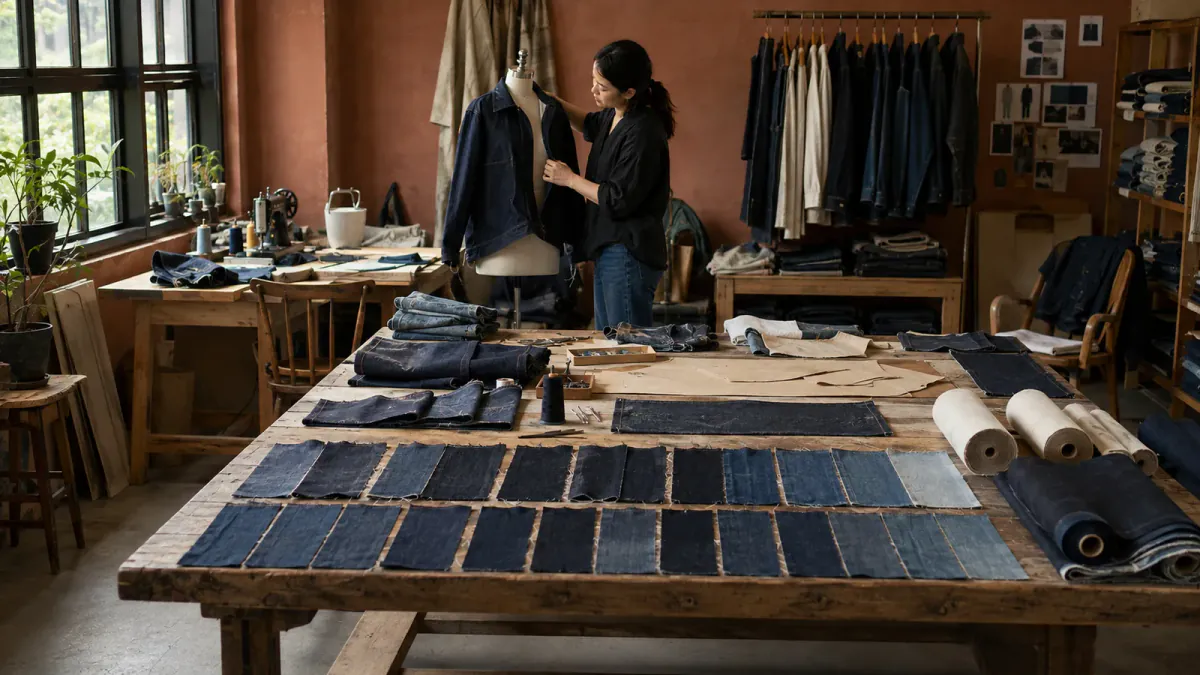
Denim is an especially articulate fabric for a public design programme. Its twill structure, weight, wash, fading, seams, and familiar workwear codes make transformation easy to read. A designer can shift the material through proportion, treatment, tailoring, deconstruction, or an unexpected relationship between softness and structure.
That familiarity is an asset. Viewers arrive with a visual memory of jeans, jackets, uniforms, and subcultural dress. The design question becomes clear: what has changed, and how convincingly does the garment carry the change? A cropped jacket and an elongated one may begin with the same cloth yet produce entirely different attitudes through balance, closure, shoulder, and volume.
The Denim Voyage Party put more than 30 creations into motion, while the surrounding exhibitions and workshops widened the encounter beyond the show. That combination suits denim because the material rewards both distance and scrutiny. A runway can reveal swing, stance, and styling. A closer setting can show topstitching, panel work, wash variation, and the physical logic of the cloth.
Conversation Completes the Fashion Picture
The forums bring another register to the programme. A designer speaking about fit development, sourcing, production scale, or retail strategy can illuminate decisions that remain invisible in the garment. This is where creative intention meets the practical systems required to carry a collection into the world.
For an emerging label, those systems are part of the design story. A strong silhouette still needs a workable sample, a production route, an intelligible price, and a way to reach the right audience. Public discussion can connect aesthetic language with the realities of making and selling clothes, allowing students, designers, buyers, and visitors to see fashion as both cultural expression and operating practice.
The most persuasive programme is therefore not one that asks every format to do the same job. It lets each format sharpen the others. Exhibition builds attention. Runway creates rhythm and image. Workshops expose process. Forums place the work within a commercial and institutional landscape. Together they create a fuller portrait of how a young designer develops visibility and vocabulary.
Visibility Is the Beginning of a Career
Public presentation matters because fashion careers depend on encounters. A garment has to be seen by people who can understand it, remember it, discuss it, commission it, stock it, or connect its designer to the next opportunity. Fashion Asia Hong Kong and the Denim Festival created settings for those encounters across public, educational, and industry contexts.
The longer commercial story unfolds after the programme. A conversation may become a request for technical information. A promising sample may lead to a meeting about production or distribution. An exhibition may give a designer a clearer account of which details audiences respond to. These forms of follow-through are quieter than opening night, but they are how exposure begins to acquire professional weight.
Hong Kong's strength here is the range of entry points. A visitor can meet fashion through a garment, a show, a workshop, or a conversation. A designer can present not just a finished look but a method, material intelligence, and point of view. The programme makes room for fashion to be studied, enjoyed, and discussed as an evolving practice.
The Hong Kong Fashion Fest programme gathers the wider 2026 schedule and event archive. The Newsroom's September fashion calendar places Hong Kong within a broader month of international presentations.
What distinguished these September programmes was not one claim of arrival, but a well-judged architecture for discovery. Denim supplied a material language with deep cultural memory. Emerging designers supplied new propositions. Hong Kong supplied the spaces in which audiences could look closely, watch the clothes move, and hear how creative ideas become fashion practice.