Two Workwear Icons Meet in One-Off 501s
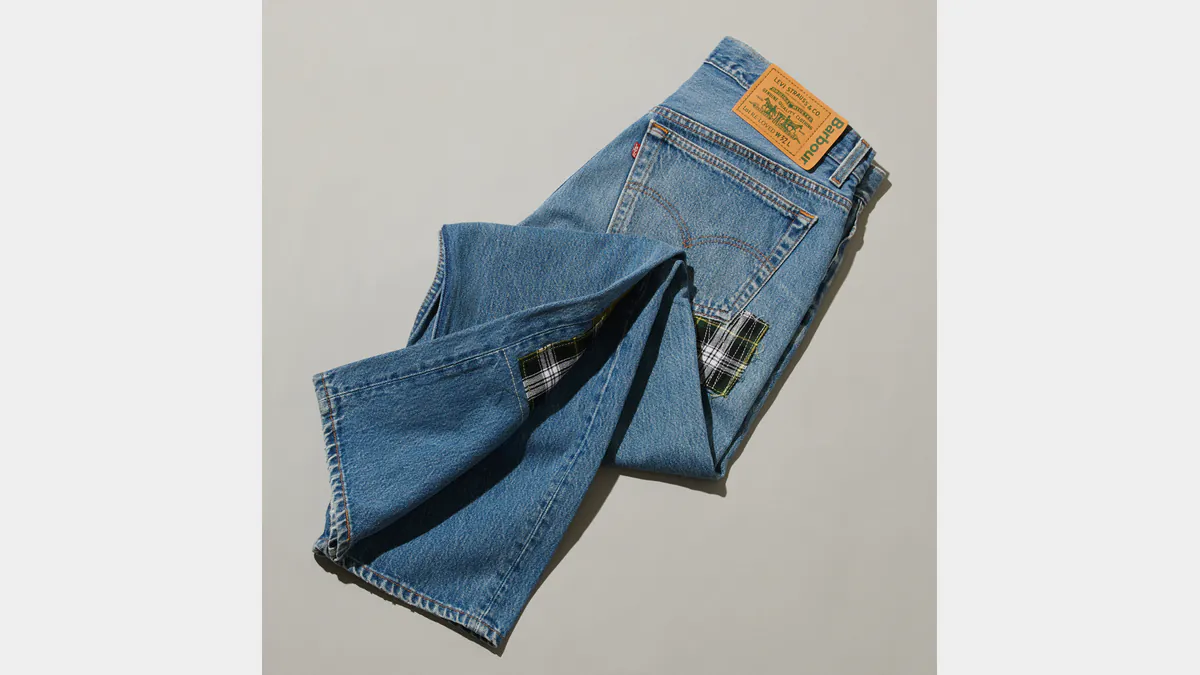
Levi's Japan and Barbour have rebuilt the 501 as a singular patchworked object. The Levi's × Barbour Re-Loved capsule , released in Japan on September 11, begins with vintage Levi's denim and introduces waxed cotton, tartan, and wide-wale corduroy drawn from Barbour's material vocabulary. Every pair carries a different arrangement of recovered cloth.
The collaboration works because the two brands bring recognizable forms of wear to the same garment. The 501 arrives with the fade, abrasion, and shape of vintage denim. Barbour contributes the patina and texture of waxed outerwear, the graphic interruption of tartan, and the plush ridge of corduroy. Reconstruction does more than place two logos together. It gives their histories a physical point of contact.
Barbour's notice confirms the same release date and the Harajuku presentation. Levi's priced the reconstructed jeans at ¥38,500 through its Harajuku flagship, while Barbour listed pairs at its Harajuku Cat Street store. Levi's used an entry-order lottery for its launch, reflecting the limited and individual nature of the pieces.
The Pair, Not the Product Shot, Is the Story
Because each jean is assembled from recovered materials, variation is part of the design. One campaign image can establish the capsule's language, but the individual pair determines the actual placement of tartan, waxed cotton, corduroy, wear, and repair. Selection becomes closer to choosing a vintage garment than ordering a perfectly standardized style.
That makes the 501 an ideal base. Its five-pocket architecture and straight, familiar outline are legible enough to hold a forceful intervention. The reconstruction can interrupt the surface without erasing the jean beneath it. Patches become punctuation. A waxed panel changes sheen and hand. Tartan introduces pattern against indigo. Corduroy adds weight and a different rhythm of texture.
The most rewarding way to read a pair is in layers. First comes the underlying 501, including its vintage measurements, fade, and condition. Then come the Barbour materials and the visual balance they create. Finally comes the workmanship that joins the fabrics and turns accumulated wear into a new composition. Each layer contributes to the garment's character.
This also makes fit wonderfully specific. The 501 name offers a point of reference, while a vintage base and later reconstruction make the measurements of the actual pair decisive. The right jean is not simply the preferred patch layout. It is the one in which silhouette, condition, intervention, and wearer come together.
Visible Repair Becomes a Design Language
The Re-Loved 501 treats intervention as something to see. Rather than disguising the fact that a garment has been remade, it lets contrasting cloth and stitching declare the next chapter. That directness gives the jean a graphic energy and honors repair as a creative act.
This is where the collaboration moves beyond nostalgia. Levi's and Barbour both possess deep workwear associations, but the capsule does not merely reproduce an archival uniform. It cuts across familiar codes and recomposes them. American denim meets British country cloth in Japan, and the result belongs to the global fashion culture that has long collected, repaired, styled, and reinterpreted both.
The styling possibilities are generous. Against a quiet knit, plain shirt, or simple jacket, the reconstructed jean can carry the entire look. The checks and material shifts become focal points, while the 501 shape keeps the composition grounded. A denser workwear mix can be equally persuasive when the proportions and textures are controlled rather than accumulated indiscriminately.
What makes the piece compelling is not an invented biography for every scrap of cloth. It is the visible evidence of use and transformation. The garment has passed through wear, recovery, selection, and reconstruction, and its surface records that process without needing to turn an unknown previous owner into a marketing character.
Reuse Is Most Convincing at Garment Scale
Upcycling describes the conversion of existing materials into a new product, and the capsule offers a clear design example. Levi's says the pieces use collected and reused materials, while Barbour's Re-Loved programme is built around recovering, cleaning, repairing, rewaxing, and reselling unwanted wax jackets.
The environmental story remains specific to those actions. The announcements identify recovered inputs and reconstruction, but they do not publish a comparative impact measurement for the finished capsule. The strongest claim is therefore the one visible in the garments themselves: existing jeans and Barbour materials have been given a new fashion life through repair and recomposition.
Care becomes part of that life. Denim, waxed cotton, tartan, and corduroy age differently and may call for different handling. A reconstructed piece also concentrates attention on future repair. Its value lies partly in accepting that clothes can continue to change, and that another intervention need not diminish the design.
This emphasis connects with the Newsroom's Redress Design Award coverage, where circular design becomes most meaningful when an idea reaches a real product and a wearer. Here, the product is deliberately individual from the outset.
A Classic Gains Another Life
The broader Levi's denim family provides the stable reference against which the reconstruction reads. Readers exploring that standard range can visit the Levi's Amazon store I may earn a commission. The Japan Re-Loved capsule is a separate, limited retail proposition and is not presented as available there.
The collaboration succeeds as a fashion idea because it understands the power of a known silhouette. The 501 remains recognizable, yet no two reconstructed pairs need tell the same visual story. Barbour's materials bring weather, texture, and pattern into denim's familiar frame, while visible repair turns difference into desirability.
At the scale of one pair, the capsule feels both archival and alive. It celebrates the marks clothes acquire, the intelligence of repair, and the pleasure of finding a garment whose particular combination cannot be repeated. A classic has not been preserved behind glass. It has been cut, joined, and sent back out to be worn.