London Puts the Hand Back Into Fashion
London Fashion Week arrives with the hand of the maker firmly in view. Selvedge's September preview reads the season through textiles, construction, repair, and the creative possibilities of a slower, more intimate relationship with clothes. It is a welcome lens for a city whose most compelling fashion has always found energy in process as much as polish.
The preview moves across designers including Paolo Carzana, Phoebe English, Bethany Williams, Anciela, Nicholas Daley, Petra Fagerström, and Dahlia Razzook. Their practices span natural materials, London production, textile transformation, decomposition, bespoke cloth, pleating, printing, and embroidery. The common thread is not a single aesthetic. It is an insistence that how a garment comes into being can shape how it looks, moves, and means.
That conversation began before the official show dates with a September 11 evening at Conway Hall. Out of Fashion: Conversations, Craft, Clothing & Circularity brought together two panels hosted by Safia Minney, with Selvedge founder and editor Polly Leonard among the speakers. Making, mending, clothing care, and circular wardrobes moved from backstage concerns to the center of the room.
Craft Is a Visible Fashion Decision
Craft earns its place in fashion criticism when it is described with precision. A hand-finished seam can redirect the eye. Embroidery can change the weight and rhythm of a surface. Pleating can build volume, collapse it, or create movement between digital planning and manual control. Textile engineering can make construction part of the garment's expression rather than a hidden support.
Selvedge highlights Paolo Carzana's engagement with fabrics, threads, dyes, and buttons derived from the earth, and Phoebe English's use of surface, structure, and textile engineering within a London studio practice. Nicholas Daley brings bespoke textiles and music into menswear. Petra Fagerström works between digital and hand pleating, while Dahlia Razzook layers silk, digital printing, and hand embroidery into elaborate surfaces.
These are distinct design languages, not interchangeable examples of virtue. Their interest lies in what each technique contributes to silhouette, texture, movement, and identity. London is at its best when material experiment produces fashion with an unmistakable attitude, and when craft feels alive rather than reverential.
The official London Fashion Week schedule separates catwalks, presentations, and other formats across the September 17 to 21 programme. That variety matters for craft. A runway reveals movement and proportion. A presentation allows longer attention. Close imagery can expose a stitch or surface treatment that distance conceals. Each format offers a different route into the work.
Repair Extends the Creative Life of Clothes
Repair becomes most persuasive when it enters the design language rather than appearing as an afterthought. A worn cuff, damaged fastening, or torn pocket can be treated as a failure to hide, or as an invitation to work with the garment's existing structure. Access, replacement materials, and the ability to preserve fit all influence whether the piece can return to use gracefully.
Selvedge points to TOAST's Renewed By collaboration with Bethany Williams, in which one-off garments are transformed through textile handcraft. The appeal is not simply that an old piece survives. It is that another maker enters the garment's story and creates a fresh reason to desire and wear it.
This is where repair culture meets fashion pleasure. A mend can be quiet and nearly invisible, preserving the original line. It can also be bold, adding contrast, texture, and authorship. Both approaches value continued use, but they offer different aesthetics. The best choice belongs to the garment, the damage, the wearer, and the intention of the repair.
Care belongs in the same creative register. Understanding how a textile responds to washing, storage, friction, and future intervention can deepen the relationship between design and ownership. A beautiful garment that welcomes maintenance has a different life ahead of it from one whose construction makes every repair prohibitively difficult.
Circularity Needs a Specific Route
The circular economy offers fashion several possible routes: maintenance, repair, reuse, remaking, take-back, material recovery, and new production models. The term becomes useful when a collection or programme identifies which route it is pursuing and at what scale.
Anciela's installation, as described by Selvedge, considers what happens to textile after disposal and follows material as it breaks down. That is a different proposition from remaking an existing garment, designing for repair, or operating a take-back scheme. Each addresses another point in the life of clothing, and each calls for its own evidence.
Visible craft can make these questions tangible without carrying every answer. A natural-looking surface does not reveal a complete fibre history. Recovered cloth does not by itself measure the impact of an entire collection. A repairable detail becomes meaningful when the skill, information, and service needed to maintain it can reach the wearer.
Precision strengthens the fashion story. It allows a reader to celebrate a beautiful intervention, understand the maker's account of its production, and distinguish that account from a measured environmental result. Appreciation and scrutiny can occupy the same front row.
London’s Strength Is in the Making
The British Fashion Council places this London Fashion Week from September 17 to 21, while the Newsroom's September fashion calendar sets it within the wider international season. London's particular contribution is its appetite for technique, subculture, experiment, and clothes that show the intelligence of their construction.
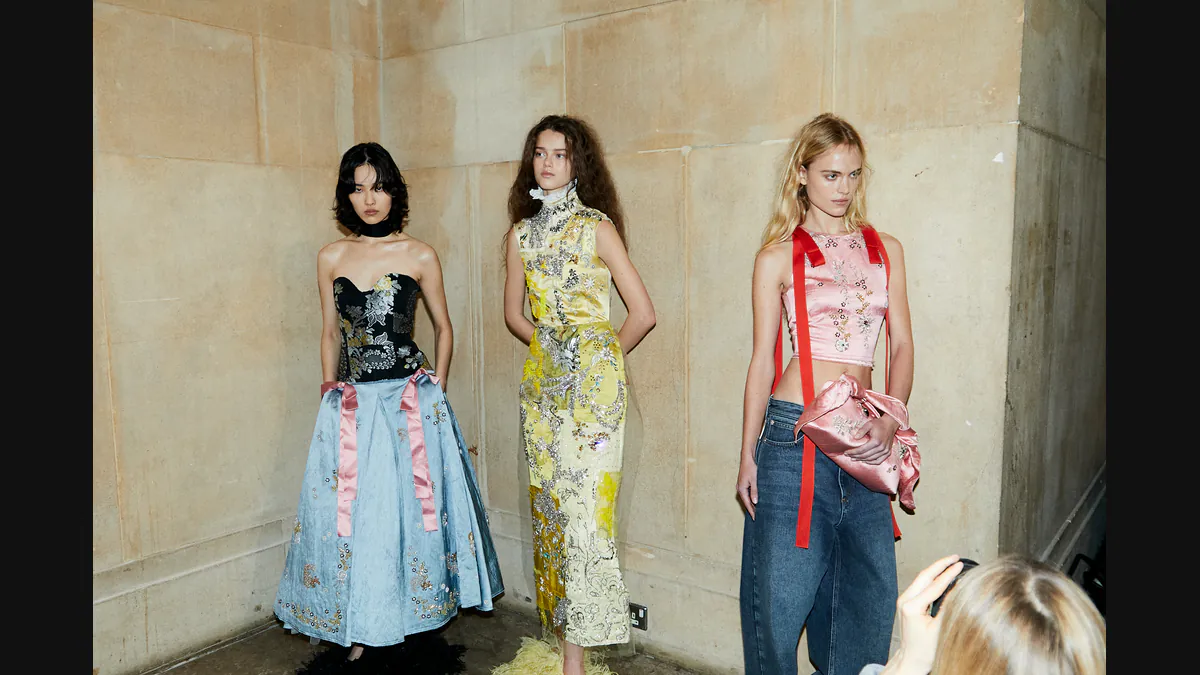
The official London Fashion Week photograph accompanying this article offers an apt visual cue. Embellishment builds density, light, and surface drama across the garments. It invites the eye to linger on construction while leaving the makers, methods, and environmental record to the sources that can establish them.
Selvedge's preview gives the season a generous starting point: watch the textile. Look for the hand, the join, the pleat, the repair, and the choices that turn material into attitude. Then follow the garment beyond its first appearance and ask how that intelligence can support a longer life.
London does not need craft to soften its edge. Craft is one source of that edge. In the hands of designers who treat making as a language, construction becomes visible, repair becomes expressive, and circular thinking gains the specificity needed to move from theme to practice.