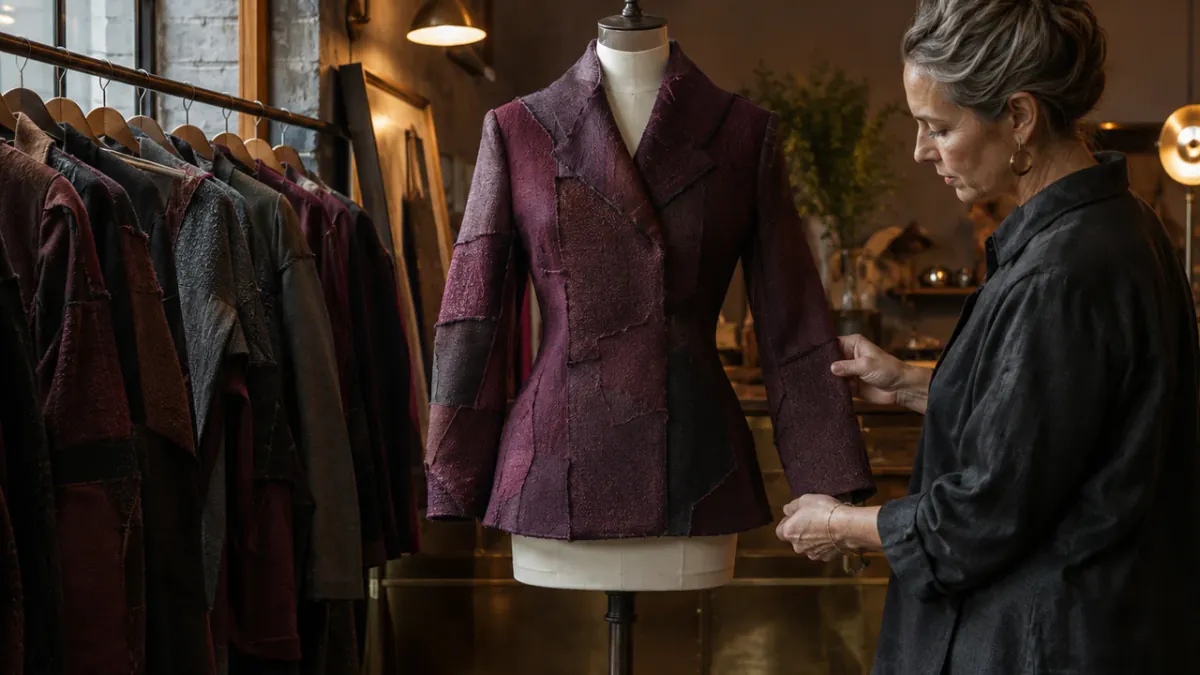
Jon Liesenfeld has won the Redress Design Award 2026 with a proposition rooted in reconstruction and upcycling, emerging from a field of eight finalists who treated textile waste as material rather than aftermath. The result gives circular design a vivid new advocate. Just as importantly, the award's Remake to Retail challenge points toward the place where these ideas become most persuasive: on a rack, in a wardrobe, and through repeated wear.
Redress named Jasmine Cheuk runner-up and Hong Kong Best winner, while Tal Zohar received the People's Choice award. Together, the results celebrate a cohort working across reconstruction, zero-waste cutting, disassembly, and material innovation. The pleasure of the competition lies in seeing those methods expressed as fashion, with silhouette, texture, and point of view leading the conversation.
Liesenfeld turns necessity into a design language
Redress's September 4 announcement places Liesenfeld's win within a runway finale at CENTRESTAGE in Hong Kong. The German designer worked from reconstruction and upcycling, two approaches that begin with existing garments or materials and remake their possibilities through cut, assembly, and finish.
On the official finalists page , Liesenfeld describes sustainability as the foundation of fashion and necessity as a source of invention. That principle gives his practice an attractive directness. Waste is not merely a problem to be hidden downstream. It becomes a condition that can sharpen the designer's eye and open unexpected routes through proportion, surface, and construction.
The other finalists broadened that picture. Alexandra Burch combined low-waste, upcycling, and zero-waste methods. Jasmine Cheuk worked through disassembly, reconstruction, and upcycling, with an emphasis on post-consumer material. Tal Zohar brought reconstruction, upcycling, and zero-waste design together. Across the group, circularity appeared not as one house style but as a set of techniques capable of supporting distinct aesthetics.
The grand final took place on September 2 , with the result announced publicly two days later. That sequence matters less as administration than as evidence of the competition's reach. The runway gave material experimentation a fashion context, allowing the clothes to be read in motion rather than as diagrams of good intent.
Circular design is strongest when the clothes lead
The finalists worked with inputs including factory surplus, discarded garments, excess stock, and furnishing waste. Such materials arrive with histories and limitations already built in. Their dimensions, wear, color, and available quantity can redirect a pattern before the first cut is made.
That constraint can be creatively generous. A recovered panel may determine the balance of a jacket. A scarred surface can become a focal point. Variations between source garments can produce a controlled irregularity that mass manufacturing usually removes. Upcycling becomes fashion when the transformation feels intentional enough to make the original material newly desirable.
This is also where craft becomes legible. Reconstruction demands decisions about seam placement, reinforcement, finishing, and the relationship between old and new components. The most convincing pieces allow those decisions to register visually without reducing the wearer to a lesson in waste management. Style remains the invitation.
Redress's competition format gives emerging designers room to make that case at full volume. A runway can amplify form and attitude, while the award attaches professional attention to work that might otherwise remain inside a graduate portfolio or small studio. Recognition matters because it enlarges the designer's field of possibility.
Remake to Retail gives the ideas a next life
The 2026 programme also brought finalists into a Remake to Retail challenge with manufacturer TAL Apparel and Hong Kong multi-brand retailer D-mop. According to the announcement, the designers remade discarded, unwearable post-consumer clothing into retail-ready collections, with a launch planned for later in 2026.
That collaboration is the article's most compelling next chapter. Retail introduces a different discipline from the runway. A garment must communicate from the rail, fit within a size and pricing structure, carry useful care information, and retain the quality that made the original idea distinctive. For remade clothing, the beauty of variation must coexist with enough clarity for a customer to understand what they are buying.
The opportunity is not to make every piece identical. It is to make difference feel authored. Material notes can identify recovered components. Product descriptions can explain which details vary. Construction can anticipate repair and alteration. These are not bureaucratic additions to the design. Done well, they extend its intelligence into ownership.
The retail launch will also give the collection a more concrete measure of connection. Availability and sales cannot establish environmental performance on their own, but they can show whether the clothes move from admiration into use. That shift matters. Circular fashion gains cultural force when people want the garment first and value its material story as part of the reason.
The award makes room for optimism with substance
Sustainable fashion coverage can become dominated by caution, metrics, and competing claims. Those questions remain important, especially when brands quantify impact. Yet an emerging-designer award deserves space for another truth: fashion changes when talented people make new methods look exciting.
Liesenfeld's win celebrates that creative proposition. Cheuk's double recognition and Zohar's public vote show a final rich in approaches rather than organized around one approved aesthetic. The field demonstrates that responsibility can sharpen design identity instead of flattening it.
The result also connects with Hong Kong's expanding platform for denim and emerging designers. Competitions, showcases, manufacturing partnerships, and retail collaborations each offer a different kind of momentum. Together, they can help a young designer move from a compelling collection to a durable practice.
Redress has supplied the celebration and the bridge. The award puts Liesenfeld's name forward, while Remake to Retail brings circular thinking closer to the wardrobe. When the collection arrives, the clothes will have the chance to complete the argument in the most fashion-literate way possible: through desire, use, and a life that continues beyond the first photograph.