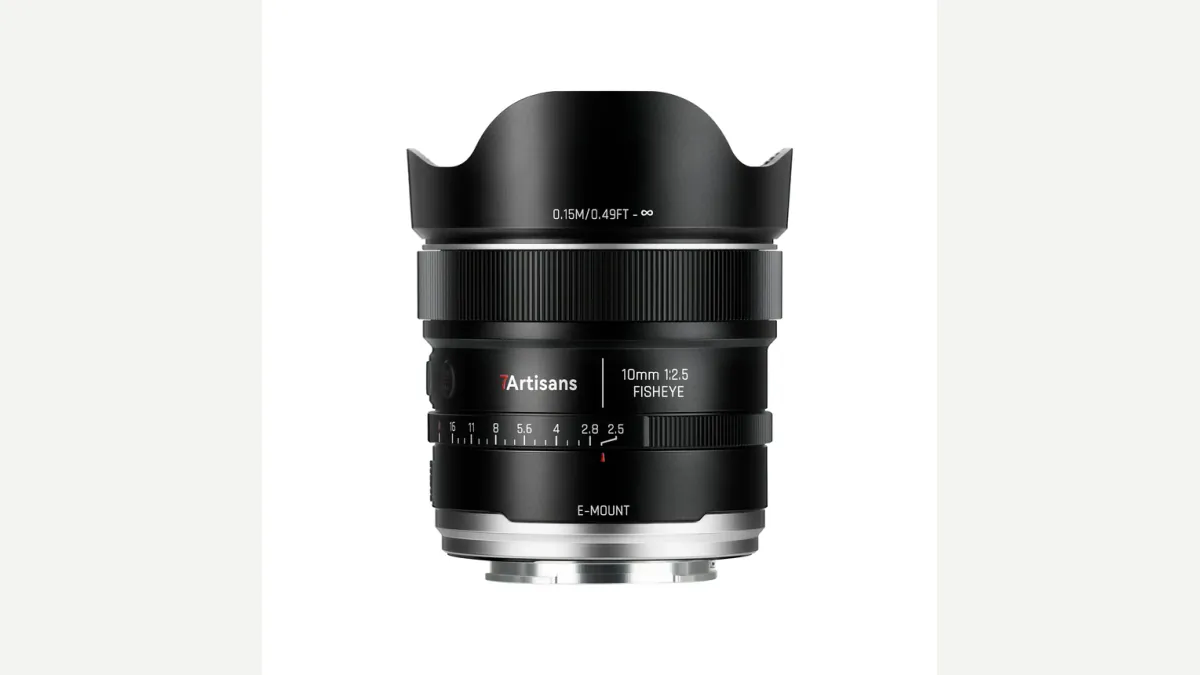
A fisheye changes the relationship between a subject and everything around it. Foregrounds swell, distant space recedes, and straight lines curve toward the frame's boundaries. With the AF 10mm f/2.5 Max, 7Artisans brings autofocus and extensive barrel controls to that expressive view at a launch price of $449.
The full-frame lens was introduced for Sony E, Nikon Z, and L-mount cameras. Its significance lies in the combination: an extreme angle of view, a bright maximum aperture, and focusing designed to follow a changing subject distance. That gives action, music, and experimental portrait photographers another way to work close while keeping a wide sweep of the surroundings in the picture.
A broad view with close working distances
The official product page specifies a 185-degree angle of view and a minimum focusing distance of 0.15 meters. The lens fills the rectangular full-frame image with a diagonal fisheye view, rather than producing a circular picture surrounded by black.
That near-to-far relationship is the creative centre of the design. A skateboard, an outstretched hand, or a performer's face can become the dominant foreground shape while the venue remains visible around it. Small movements of the camera make substantial changes to the composition because nearby objects change size quickly in relation to the background.
7Artisans lists 11 optical elements in eight groups, a nine-blade diaphragm, an aperture range of f/2.5 to f/16, and a metal body. The specification table gives an approximate E-mount weight of 504 grams, while the product presentation rounds the figure to 510 grams. Conventional screw-in filters are not supported, a practical consideration for anyone planning long exposures or outdoor video.
The f/2.5 maximum aperture is useful where light levels fall or a short shutter speed matters. Aperture alone does not determine whether an image will hold detail across the frame. Focus position, subject distance, shutter speed, and the way the lens renders toward its edges all contribute to the finished photograph.
Autofocus serves the moving foreground
A fisheye lens can make manual focusing quite manageable when a scene is distant and the aperture is small. Close subjects change that equation. A cyclist coming toward the camera or a performer leaning into the lens can move through the useful focus zone much more quickly than the background suggests.
Autofocus gives the photographer a way to follow that movement while concentrating on the instant of expression or gesture. DIYPhotography's launch coverage identifies approaching subjects as a useful application. The lens has no optical image stabilization, so camera-body stabilization, shutter choice, and physical support remain part of the shooting decision.
The most effective composition still begins with subject placement. A face near the centre and a face near the edge can appear markedly different. Moving closer increases the prominence of the foreground, while tilting the camera changes the sweep of architecture and horizon lines. With this kind of optic, a few centimetres of movement can matter more than a later crop.
For action photography, that rewards anticipating where the subject will enter the frame and leaving enough space for the movement to develop. The lens offers breadth, but the photograph needs a clear point of attention within it.
Barrel controls bring stills and motion closer together
The AF 10mm f/2.5 Max includes an AF/MF switch, a focus ring, a clicked aperture ring, and two function controls. According to 7Artisans, one supports customizable camera commands and the other supports lens functions, including A-B focus transitions between stored distances. Firmware updates use a USB-C connection.
Those controls extend the lens beyond a simple autofocus conversion. A stored focus transition can help a video composition move between a foreground subject and another point in the scene. An aperture ring places exposure and depth-of-field decisions directly on the barrel. The manufacturer's compatibility table remains the reference for the functions supported by each camera body.
DPReview places the release in a relatively thin market for full-frame mirrorless autofocus fisheyes. PetaPixel draws attention to its progression from the company's manual-focus 10mm f/2.8 and its applications in action and video. Both perspectives describe a more responsive way to use a specialised view.
These launch reports establish the design and market position. Comparative findings on tracking consistency, flare, and edge detail depend on production-sample testing with the relevant camera body.
Curvature is a compositional choice
7Artisans supplies a correction profile for photographs that need straighter geometry. That creates a second rendering option from the same lens, although converting a fisheye image changes how pixels are distributed. Straightening severe curvature can stretch the edges and reduce the usable field through cropping.
It helps to choose the intended result while composing. A photograph built around curved architecture may lose its strongest organising feature when corrected. An interior intended for straighter presentation needs room around important objects to accommodate the crop. Comparing the two renderings makes the trade-off visible: a more rectilinear space, a tighter frame, and differently stretched detail near its edges.
The broader equipment question is one of working rhythm. Kisau Photography's camera-bag discussion considers how different tools affect pace and attention. Here, autofocus and on-lens controls give the photographer more ways to stay with a moving subject while shaping an unusually wide composition.
For E, Z, and L-mount photographers, the $449 launch adds a distinctive option: a full-frame fisheye designed for close engagement and changing distances. Its strongest creative invitation is straightforward. Get close, give the foreground a purpose, and let the surrounding space become an active part of the photograph.