A Coastal Setting Gives the Clothes a Different Frame
Givenchy 's Winter 2026 women's campaign brings Sarah Burton's collection into the open, with photographs by Juergen Teller made in Croatia. The house's campaign credits name Burton for direction, Camilla Nickerson for styling, and M/M for campaign creative direction. The cast includes Eva Herzigova, Constance Debré, Kaia Gerber, Liu Wen, and Nyaduola Gabriel.
The change of setting reshapes the photographs. Pale ground, rough stone, coastal structures, and glimpses of water create a textured field around the clothes. A sharply defined silhouette has something substantial to stand against. The location contributes lines, surfaces, and scale to each composition.
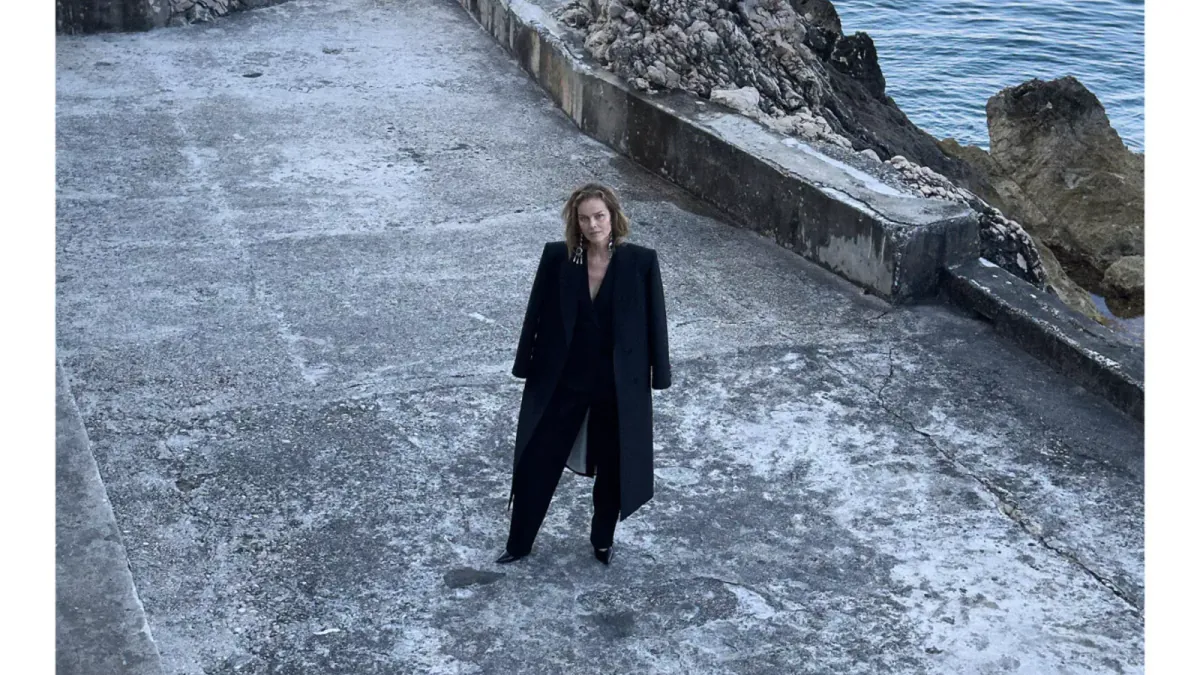
The featured image makes that relationship especially clear. A figure in black tailoring stands within a broad expanse of mottled grey ground. The camera looks down, allowing the surface to occupy much of the frame. A low wall runs diagonally toward the upper edge, with rocks and water beyond. The dark outline of the clothes gives the eye an immediate point of focus.
Texture and Camera Position Carry the Composition
That high viewpoint changes the balance between person and place. Instead of lifting the figure against a large sky, it places the body within the terrain. The surrounding space becomes part of the portrait, and the figure's stance remains readable through its contrast with the lighter ground.
The diagonal wall gives the image a second organising line. It leads away from the subject and establishes depth, while the sea occupies a relatively small area. The coast is present through its materials and spatial relationships, rather than through a conventional scenic panorama.
For photographers, this is a useful example of location doing compositional work. A surface can separate a silhouette. A wall can direct attention. An uneven edge can give a precise garment a different visual rhythm. The relationship depends on where the camera stands and how much of the setting enters the frame.
Croatia Week identifies Makarska as the location, situating the production between the Adriatic and the Biokovo landscape. That geographic context adds specificity to the campaign's coastal setting.
Clothing Gains Definition Through Contrast
V Magazine's account draws attention to the range of clothes and accessories: tailoring, leather boots, a black dress, jewelled detail, and concentrated passages of colour. Against the subdued terrain, those differences in surface and silhouette become important photographic elements.
A dark coat reads first as shape, then as cut and texture. A reflective detail catches attention in another way. Saturated colour can establish an accent within a largely grey field. The location gives each treatment a common background while allowing the clothes to register differently.
These relationships suggest a practical way to assess a location before a fashion shoot. Consider the tonal separation between wardrobe and background, the kinds of edges the setting supplies, and the distance at which the garment remains legible. A location's photographic value lies in those working relationships.
The same site can support several pictures when camera height, distance, and framing change. A wider photograph can establish scale. A closer frame can bring gesture and fabric forward. Together, those variations give an editorial sequence both continuity and movement.
From Schorr's Studio to Teller's Coast
The contrast with Givenchy's Summer 2026 campaign is instructive. Photographed by Collier Schorr, that earlier campaign used a spare interior setting. The Impression's review describes clean walls, minimal furniture, and the atmosphere of a working studio.
Its cast included Isabelle Albuquerque, Selena Forrest, Kaia Gerber, Annie Leibovitz, and Liu Wen. The review read the studio context as a place of collaboration and making. In visual terms, its restrained surroundings placed emphasis on posture, gesture, and the arrangement of the clothes.
Gerber and Liu Wen also appear in Winter 2026. Their return creates continuity as the campaign moves into a different environment. Givenchy describes the winter cast as part of Burton's wider creative community, including participation in fittings and the runway presentation.
The photographic shift is therefore visible in the conditions around the subjects. Studio geometry gives way to coastal surfaces and more expansive space. The clothes and cast connect the campaigns, while setting and camera position establish a different rhythm.
Give the Location an Active Role
A direct-looking fashion photograph is built through concrete choices: casting, styling, position, light, framing, and selection. In the featured campaign image, the broad ground plane and high viewpoint are as important to the portrait's character as the tailoring itself.
That offers a useful principle for fashion editorial photography . Define what should remain consistent across the work, such as the treatment of the subject or the clarity of the silhouette. Then choose a setting that brings another visual relationship into play.
The aim is a coherent encounter between clothes, person, and place. Givenchy's Winter 2026 campaign makes that encounter visible through the contrast between exact tailoring and textured coastal space. Teller's framing gives the terrain a substantial role while keeping the figure legible within it, turning location into part of the portrait.