One Bag, Four Chapters
For Kisau Photography , I photographed Shopping Is a Girl’s Best Friend around an object large enough to change the proportions of a studio portrait. The oversized polka-dot bag could surround Stacy Huang, hold the clothes she discovered, or become something she carried. Those changing relationships connect four chapters titled Dream, Discovery, Style, and Possibility.
Huang modeled the story, Henri Cheung filmed it, and designer Skip Pas supplied the West Coast Leather wardrobe. Each contribution works within the same visual premise. The bag gives the sequence a recognizable shape, while gesture, clothing, and color establish its movement. A viewer can follow the photographs through that recurring object even as the styling changes.
Sequencing a Visual Narrative Using a Single Prop
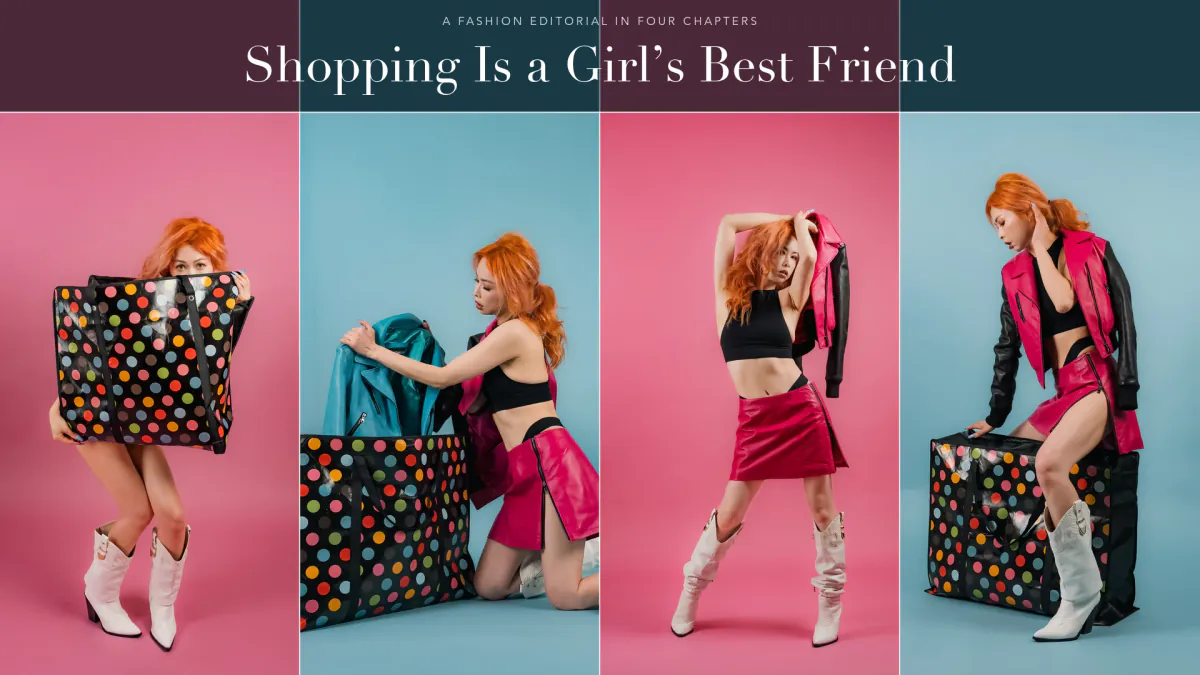
Dream begins with Huang enclosed by the bag. Its scale makes the familiar shopping accessory look almost architectural, with her head, arms, and white boots marking the human figure within it. Discovery opens that arrangement. Reaching inside and drawing out garments turns the bag into a source of actions. Style gives the clothes and Huang’s performance more space, before Possibility brings her back to the object with a different bearing.
The progression depends on changes in agency. Early images let the bag dominate the figure. Later poses show Huang handling it with greater ease. That shift gives the sequence a direction, linking the fashion to a character’s changing relationship with her surroundings.
For a photographer planning a series, this offers a concrete way to develop a brief. List the actions an object makes possible, then arrange them by how they change the subject’s presence. A chair might support a seated portrait, interrupt a standing figure, or become something carried across the frame. Each use suggests a different silhouette and distribution of weight.
A chapter can have a clear purpose while leaving gestures open. Reaching, turning, lifting, and leaning all offer small changes in balance and expression. Directing an action gives a model something to respond to, and gives the photographer transitions to watch between the more composed poses.
Applying Color Theory to Studio Set Design
Pink and blue backdrops hold the story together across its changing looks. The black bag provides a consistent dark shape, while its colored dots echo the brighter wardrobe. Orange hair and white boots remain visible reference points as Huang moves between enclosed poses, kneeling gestures, and open standing figures.
The lead collage makes those relationships especially clear. A teal garment stands out against the blue set as a distinct material and shape. Fuchsia connects the clothing to the pink background, while black sleeves and the bag define stronger edges. The effect draws on color theory , but also on differences in surface, outline, and proportion. Hue alone does not account for the separation.
That is a useful distinction when styling a studio photograph. Two similar colors can work together when a garment’s contour stays legible. A stronger hue contrast may still lose clarity if the pose merges important edges. Look at the body, clothes, prop, and background as one arrangement.
Reviewing the sequence as a contact sheet brings another level of control. Pink and blue frames can alternate to change the rhythm, while repeated black and white elements keep the edit connected. The palette allows variation without requiring a new setting for every look.
Wardrobe That Gives the Model Something to Do
The wardrobe grew from a visit to the San Francisco boutique of West Coast Leather , where I met founder and designer Skip Pas. Fuchsia and teal Italian leather suited the saturated sets and gave the photographs structured shapes to work with.
Bringing garments out of the bag makes dressing part of the story. A jacket changes the outline of an arm when it is held overhead, then changes the upper body when worn. Comparing, lifting, and putting on clothes creates a sequence of physical decisions. The viewer sees fashion being handled and inhabited.
Skip Pas described how the wardrobe choices supported the concept: “When Paul visited the boutique in San Francisco, we knew right away which pieces would pop for this concept. The cropped jackets and strong colors perfectly matched the energy of the oversized prop. It is always great to see our designs integrated into a sequence that has a real beginning, middle, and end.”
An early photoshoot collaboration gives the designer’s contribution room to shape the images. Color, cut, and movement can inform the brief, the model’s actions, and the final order of the photographs.
Building a Brief Around a Physical Possibility
I found the oversized bags in Japan. Their proportions suggested that someone could climb inside or wear one, and that possibility became the starting point for the studio story.
A specific object gives a team something tangible to develop. Its size determines how much of the frame it occupies. Its opening suggests concealment and discovery. Its handles suggest carrying. Those properties become prompts for composition and performance.
The four-chapter structure organizes those prompts into a progression. It also provides a useful editing question: what changes in this frame? A photograph earns its place by adding a gesture, revealing clothing, altering the figure’s relationship with the bag, or giving the sequence a pause.
Practical Lessons for Fashion Photographers
- Define the narrative job of each chapter, then leave room for the model to find its gestures.
- Give a recurring prop several roles so continuity can develop into a story.
- Build wardrobe actions into the brief, including lifting, comparing, dressing, and carrying.
- Judge color through outline, surface, and the complete edit as well as individual hues.
- Select photographs for the changes they introduce, balancing expressive frames with quieter transitions.
The complete gallery sits within Kisau Photography’s fashion editorial photography . For another approach to placing a figure within a visual structure, the Newsroom’s portrait composition tutorial explores depth, camera position, and framing.