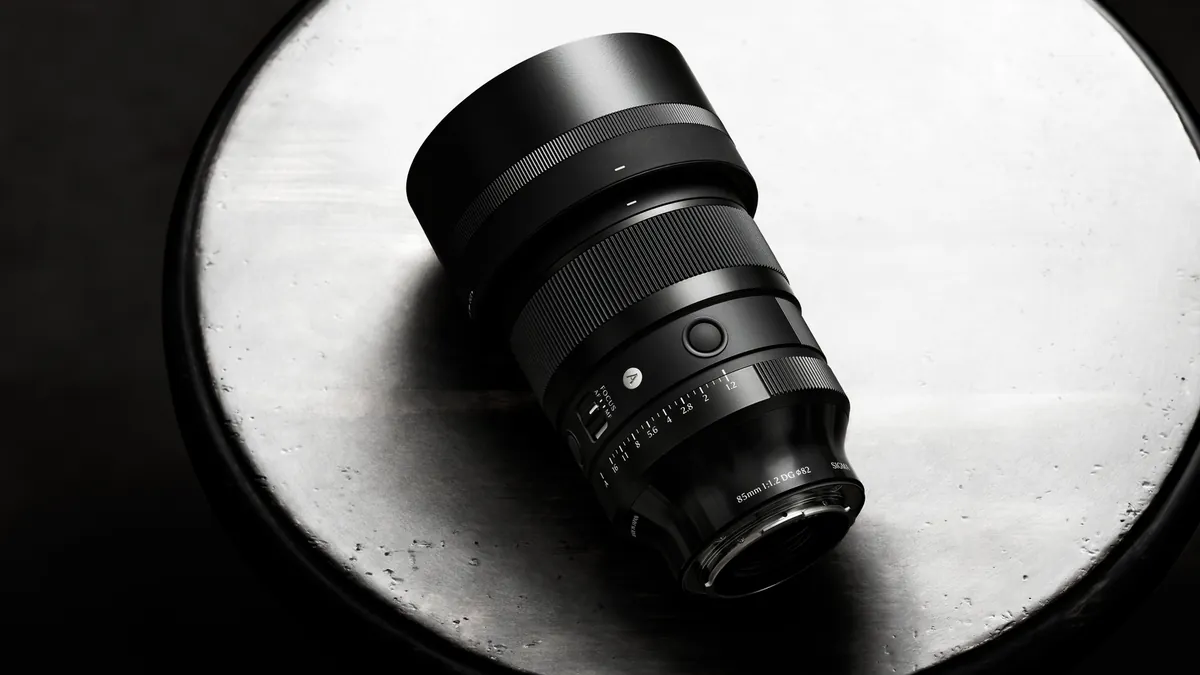
An F1.2 Portrait Lens With Two Useful Comparisons
Sigma announced the 85mm F1.2 DG | Art on September 8, 2026. This first look considers its launch specification, the independent reviews published that week, and its place beside established f/1.4 portrait lenses.
The 85mm F1.2 DG | Art brings a 905-gram body, a 13-blade diaphragm, and dual-motor autofocus to Sony E-mount and L-Mount. It offers a brighter maximum aperture than Sigma's existing 85mm f/1.4, while remaining a substantial lens to carry through a portrait session.
Two comparisons make its position clear. Sony's FE 85mm F1.4 GM II provides a lighter first-party E-mount option. Sigma's older 85mm F1.4 DG DN | Art offers a particularly compact alternative and a familiar reference for photographers already working with its rendering.
For me, that second comparison is personal. The older Sigma is my favorite lens, and I used it throughout my Melbourne Portraits Project. The arrival of an f/1.2 version raises a photographic question I am keen to explore: how will its transition from a sharply focused person to the surrounding place shape the portrait?
Availability and the Working Specification
Sigma's global launch notice gives September 30, 2026 as the availability date. Sigma Corporation of America specifies October 6 for the United States and a $1,599 retail price.
The optical design uses 17 elements in 12 groups, including two SLD elements and three aspherical elements. Minimum focus is 0.84 meter, maximum magnification is 1:8.9, and the filter thread is 82 millimeters.
The handling controls are designed for frequent use: two assignable AFL buttons, an aperture ring, a click switch, and an aperture-lock switch. Sigma specifies dust- and splash-resistant construction and a water- and oil-repellent front coating. Autofocus uses two High-response Linear Actuators, with a floating arrangement that the company says helps limit focus breathing.
Those features connect the lens's wide aperture with the practical work of portraiture. Focus must settle on the intended plane, controls need to remain easy to reach, and the lens has to balance comfortably as the photographer moves between horizontal and vertical frames.
What the Early Reviews Find
PetaPixel's review reports strong detail at f/1.2, very slight longitudinal chromatic aberration, fast focusing, and limited focus breathing. It also describes a gentle reduction in contrast wide open and a warm veiling flare with backlit subjects.
Those observations speak to different aspects of portrait rendering. Fine detail gives the eyes and clothing definition. The transition into defocus controls how the face separates from its surroundings. Flare can soften contrast across the frame and change the atmosphere of the light.
Digital Camera World's review also finds strong wide-open performance and smooth transitions. Its laboratory comparison places equivalent Canon and Nikon lenses slightly ahead for sharpness at f/1.2, while Matthew Richards considers the difference difficult to distinguish in ordinary photographs.
Bokeh concerns the character of out-of-focus areas, not just their size. Look at bright points, overlapping branches, foreground blur, and the transition around hair and shoulders. A portrait lens's character emerges across those relationships.
Sigma F1.2 and Sony F1.4 in E-Mount
Sony's FE 85mm F1.4 GM II offers a distinct balance of aperture, size, and integration. The official Sony specifications make the physical comparison straightforward.
| Specification | Sigma 85mm F1.2 DG Art | Sony FE 85mm F1.4 GM II | | --- | --- | --- | | Maximum aperture | f/1.2 | f/1.4 | | Weight | 905g | 642g | | Diameter × length | 87.2 × 121.7mm | 84.7 × 107.3mm | | Filter thread | 82mm | 77mm | | Diaphragm blades | 13 | 11 | | Minimum autofocus distance | 0.84m | 0.85m | | Autofocus drive | Dual HLA | Dual XD linear motors |
The Sony is 263 grams lighter and 14.4 millimeters shorter. Its United States page lists $1,949.99, compared with Sigma America's $1,599 launch price. Sony also specifies support for the Alpha 9 III's high-speed shooting capability with compatible settings.
The Sigma's wider aperture offers more scope for shallow depth of field. The Sony puts less weight in the hand. At portrait distances, both choices need to be considered alongside the camera body, the subject's movement, and how much of the face and surroundings should remain legible.
The Earlier Sigma Remains a Strong Working Reference
The 85mm F1.4 DG DN | Art weighs 625 grams in Sony E-mount and measures 96.1 millimeters long, with a 77-millimeter filter thread. Compared with it, the f/1.2 adds 280 grams and 25.6 millimeters of length.
That difference becomes tangible during a long location session. A smaller lens can be easier to keep ready while walking, directing, and changing position. The wider-aperture lens offers another way to organize focus and background, particularly when the portrait benefits from a narrow plane of definition.
A useful comparison starts at the same subject distance and framing. Photograph busy foliage, reflective backgrounds, and backlit hair. Make a short sequence with gentle movement, then compare focus accuracy as well as the finished image. The Newsroom's apodization-lens guide develops that approach to judging bokeh in the complete photograph.
A Personal Reason to Look Forward
My Melbourne Portraits Project became a 192-page book shaped by more than 100 photoshoots across two years. The older Sigma 85mm f/1.4 helped me move between natural light, architecture, street scenes, and close portraits while keeping a consistent visual language.
I valued its balance of detail and softness. It could give a person presence while leaving enough of Melbourne in the frame to make the location meaningful. That experience is why I look forward to photographing with the f/1.2.
The most interesting comparison will be the relationship between a face and a place: what stays distinct, what recedes, and how smoothly the image moves between them. Sigma's new 85mm offers another set of choices for making that relationship expressive.