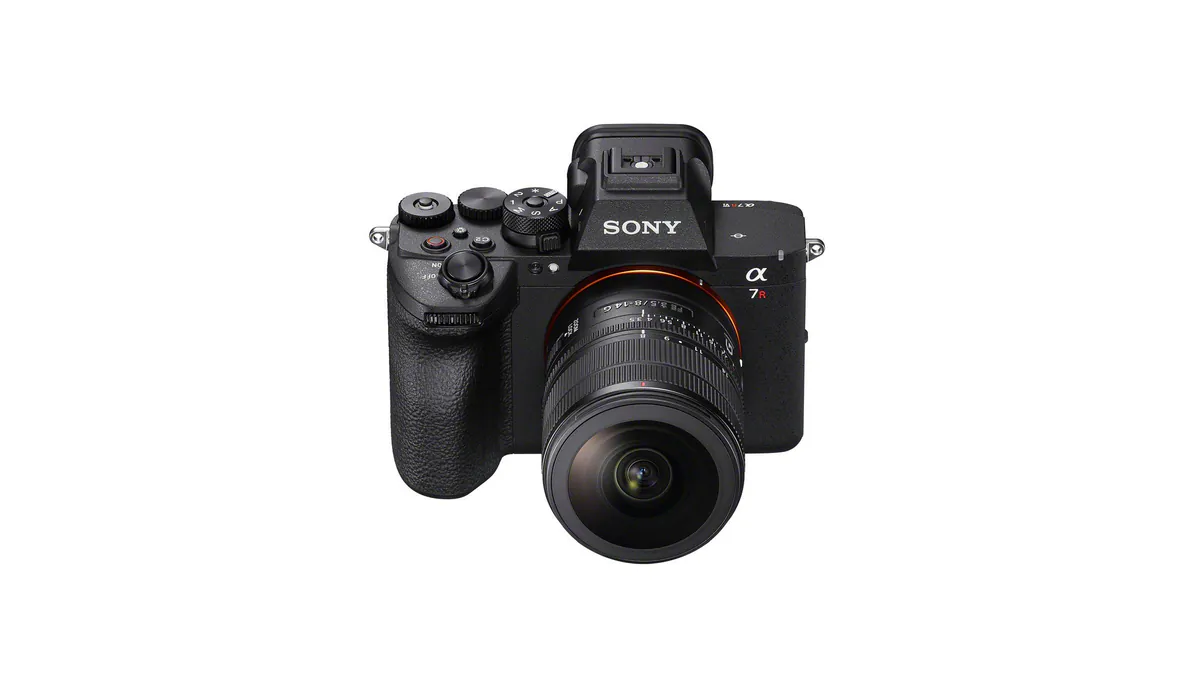
Two picture shapes, one viewpoint
Sony’s FE 8–14mm F3.5 Fisheye G makes the boundary of the photograph part of the lens choice. On a full-frame camera, 8mm produces a complete circular image, while 14mm fills the rectangular frame. Both encompass 180 degrees, measured across the circle at the wide end and diagonally at the long end.
Sony’s announcement gives the lens a US suggested price of $1,599.99 and October 2026 availability. Its constant f/3.5 aperture and full-frame E-mount design place that change of framing within a single zoom. The creative distinction is substantial: one photograph presents the world inside a visible circle, while the other carries the scene to the corners of the page.
That difference offers a useful starting point for a shoot. Decide whether the image should feel self-contained, like a window onto an enclosing space, or expansive, with people and architecture extending beyond its edges. The lens can accommodate either approach from the same camera position.
Compose with the curve
A fisheye projection maps a broad field of view differently from a rectilinear wide-angle lens. Lines away from the image center can curve strongly. Those curves are part of its visual language, giving roofs, railings, avenues, and the horizon a different relationship to the subject.
Inside a domed hall, a circular frame can gather the ceiling and surrounding structure into one enclosing form. Place a person beneath that dome and the composition gains a scale reference. At the diagonal endpoint, the same space can reach the corners, with the figure anchoring a more conventional rectangular image. These are two ways of organizing the scene, rather than simply two degrees of width.
Camera height becomes especially expressive. Lowering the viewpoint brings paving, steps, or equipment forward. Raising it changes how the roof and distant figures balance. Work through those positions deliberately and watch where curves converge. A strong foreground shape can lead into the photograph, while several competing arcs can scatter attention.
Keep the main gesture legible. In a sports portrait, an athlete’s stance may matter more than including every part of the venue. In an architectural photograph, one structural rhythm may carry the composition more effectively than a crowded inventory of details. The broad view creates room for context, and the photographer supplies the hierarchy.
Give the foreground a role
Sony specifies a 0.15m minimum focusing distance and 0.22x maximum magnification at 14mm. Those figures invite compositions that combine a prominent nearby element with the surrounding setting. The announced weight is 314g, and the internal zoom keeps the lens from extending as focal length changes.
Foreground placement deserves as much thought as focus. A bicycle wheel, instrument, or piece of sports equipment can introduce the person behind it. A stone ledge can establish a path toward the building beyond. Choose something that contributes to the subject’s story, then adjust distance until its scale feels purposeful.
Check people near the edges with particular care. A face can become visually secondary or awkwardly stretched within a composition that otherwise feels energetic. Moving the camera, asking for a small change in position, or simplifying the background may resolve the problem more effectively than planning a heavy crop later.
An encompassing view also gathers small intrusions. Scan the entire boundary for a camera bag, stand, foot, or bright fragment of sky. With a circular image, that means following the full circumference. With a frame-filling image, inspect all four corners as well as the main subject.
Plan the finished frame
Circular photographs benefit from layouts that give the image room to remain circular. A book page or exhibition print can use the surrounding space as part of the presentation. A tight rectangular website crop can remove the very boundary that made the photograph distinctive.
Start with the intended output. Sketch a circular image on the page, then a diagonal fisheye image in the same space. Consider where a caption sits, how adjacent photographs interact with the shape, and whether the sequence needs consistency or a deliberate change of pace.
Correction introduces another choice. Converting fisheye geometry toward a rectilinear view redistributes pixels and changes the usable boundaries. Our guide to correcting fisheye distortion while preserving the composition explores that editing decision. Leave room around important details when a corrected version is part of the brief, and evaluate the actual crop before committing to the layout.
Preserving the curve and correcting it can both serve a project. The useful distinction is the intended picture, not a default assumption that every curved line needs straightening.
Build a comparison around the photograph
A compact contact sheet can make the zoom’s two approaches clear. Photograph one scene at both endpoints from the same position. Repeat at a different camera height, then make a closer composition with a purposeful foreground element. Keep the sequence small enough to compare carefully.
Judge those frames at their likely display size. Look first at the subject’s presence, the balance of foreground and setting, and the picture boundary. Then inspect focus, flare, and edge detail in the situations that matter to the assignment. These are distinct questions, and each deserves attention.
A fixed-focal-length alternative, such as the lens discussed in our 7Artisans autofocus fisheye first look, asks the photographer to build around one framing approach. Sony’s FE 8–14mm product page describes a zoom that spans two. Its most interesting proposition is that compositional flexibility: the ability to decide how a scene meets the edge of the photograph while standing in front of it.